
Pressure and Gas Laws
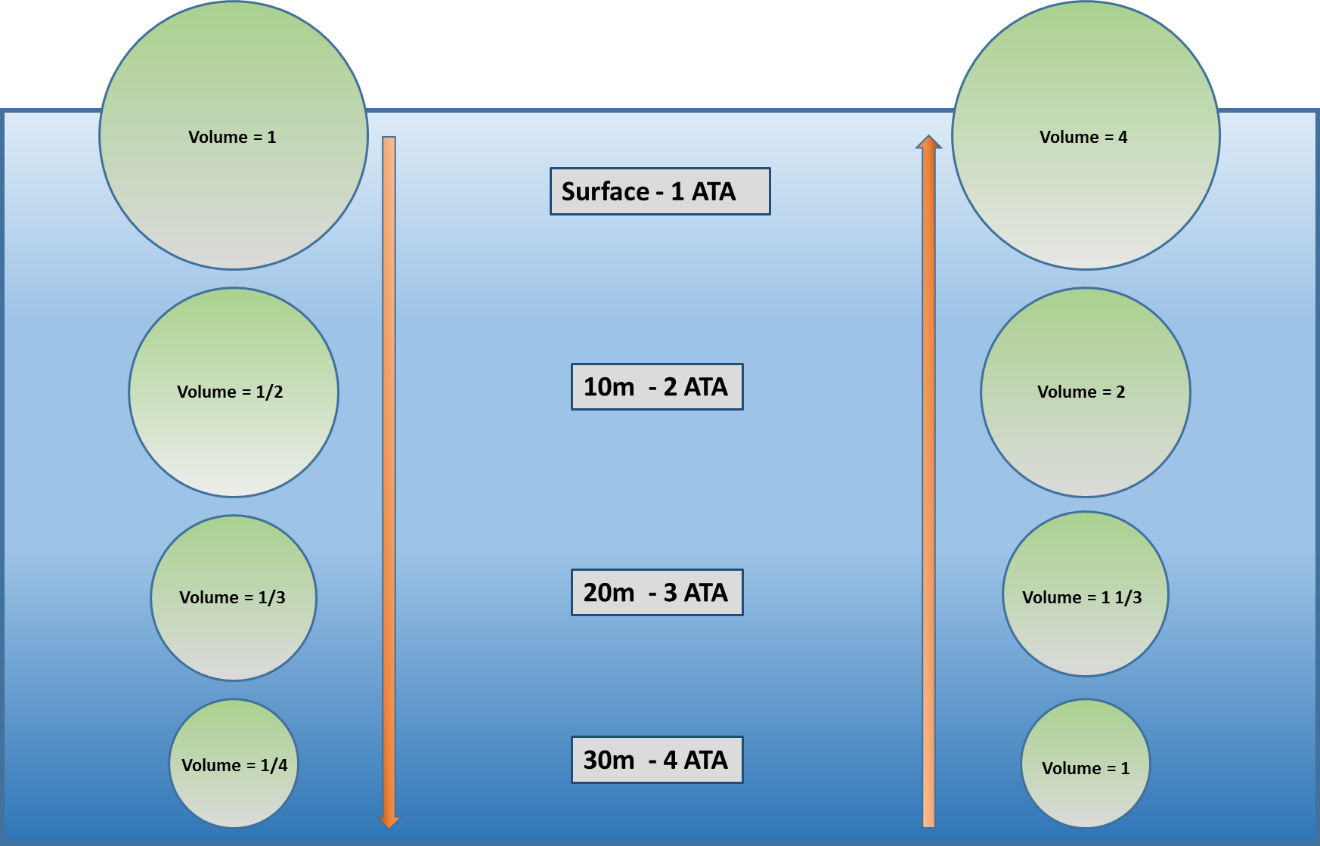
The most important concept to understand in diving medicine is pressure. Pressure can be measured in many different units – here we will focus on atmospheres absolute (ATA). At sea level, the pressure is 1 ATA. With every 10m of seawater, this pressure increases by 1 ATA.
0m: 1 ATA
10m: 2 ATA
20m: 3 ATA
30m: 4 ATA
Gas laws underpin most of basic diving physics and physiology:
- Boyle’s law
- Henry’s Law
- Dalton’s Law
- Gay-Lussac’s Law
The most important of these in diving and DCI are Boyle’s law and Henry’s law.
BOYLE’S LAW: At a constant temperature, the absolute volume of a fixed mass of gas is inversely proportional to the absolute pressure.
P1V1 = P2V2
As pressure increases, volume decreases.
Why are pressure changes relevant in diving medicine?
BAROTRAUMA = trauma caused by pressure changes
- Affects air spaces in the body- ears, sinuses, lungs
- Divers can get pain in their ears and sinuses on ascent and descent
The most dangerous is pulmonary barotrauma.
- Usually due to a very rapid ascent or divers holding their breath
- Causes lung to burst
- Can cause arterial gas embolism (a type of decompression illness)
HENRY’S LAW: At a constant temperature, the amount of gas that will dissolve in a liquid is proportional to the partial pressure of the gas over that liquid.

Why are gases relevant in diving medicine?
Nitrogen is an inert gas. This means it is not metabolised by the body and so the fraction does not change in inhaled and exhaled gas.
Nitrogen dissolves in the blood. As per Henrys law, above, more nitrogen will dissolve in the blood when the partial pressure of nitrogen is higher. As the diver descends, and the pressure increases, the partial pressure of nitrogen will increase, and therefore more nitrogen will dissolve in the blood. This called on-gassing. As the diver ascends, nitrogen will come out of solution. This is called off-gassing. The nitrogen coming out of solution can form bubbles, particularly if they ascend too fast or miss any stops on their ascent. These bubbles can lead to decompression sickness.
The nitrogen coming out of solution can form bubbles, particularly if divers ascend too fast, or miss any stops on their ascent. These bubbles can lead to decompression sickness (a type of decompression illness).
Gas mixtures
Different divers breathe different gas mixtures depending on the type of diving they are doing. Therefore, varying their exposure to inert gases such as nitrogen. The most commonly used gas is air. However, many divers also use other gas mixes such as:
- Enriched air nitrox (a higher content of oxygen than air, mixed with nitrogen)
- Heliox (helium and oxygen)
- Trimix (oxygen, helium and nitrogen),
- Pure oxygen
Learning Bite
Boyle’s law and Henry’s law are fundamental in understanding dive medicine. Boyle’s law helps to explain arterial gas embolism and Henry’s law helps to explain decompression sickness.